Decorative Ceiling Fan Basics: DC Motor, LED Kit, Smart WiFi
A decorative ceiling fan is a finished interior product - housing, blades, finish, light and controls - not simply an air mover. Three modules decide what it actually does in a room: the motor, the integrated light kit, and the control layer. This explainer compares those three modules for a buyer who is choosing a specification rather than browsing a category.
The labels overlap in most catalogues. A fan described as decorative may run on a conventional AC motor with a pull chain, or on a DC motor controlled from a phone. A fan described as 'with light' may carry a fixed white LED module or a CCT module the buyer can switch. 'Smart' says nothing about the motor underneath. Decorative ceiling fan basics is therefore a comparison problem, not a definition problem.
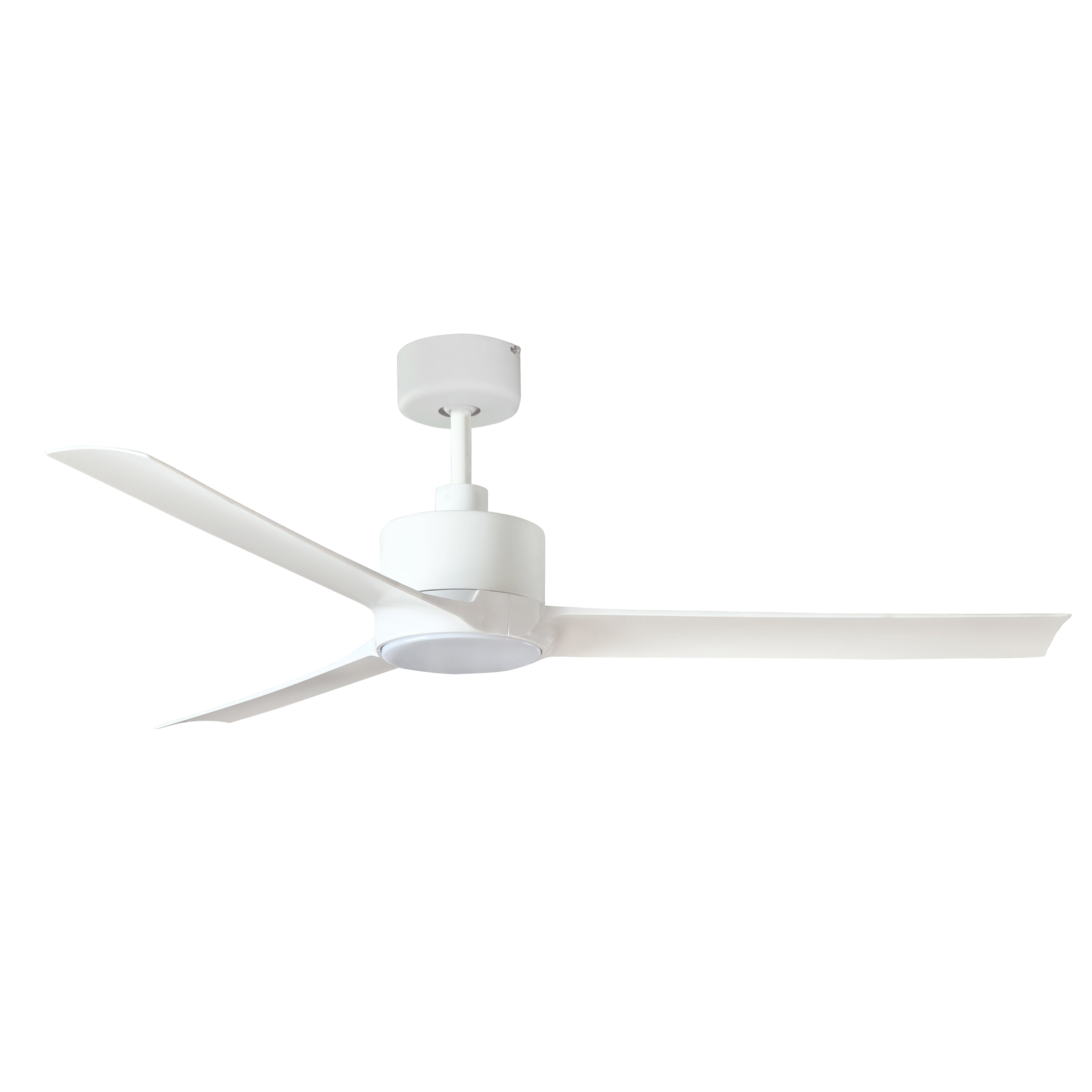
Handing Co. Ltd., a ceiling fan manufacturer established in 1992 that exports to the EU, USA and Australia, supplies the reference example used throughout this article: the TU52-MW-N3A1DOME, a 52-inch decorative model with three ABS blades, a steel housing in Matt White, a 24 W CCT LED light and smart WiFi control.
Problem definition: four label traps that decide the purchase
At decision stage the risk is not a shortage of models. It is that four different attributes are sold under one word, and each carries a separate cost when it is assumed rather than specified.
Trap 1: 'decorative' describes appearance, not performance
A decorative fan is differentiated by finish, blade shape and light integration. The same housing can sit on an AC motor platform or a DC platform, with pull-chain, remote or WiFi control. Nothing in the word decorative tells a buyer which one they are pricing.
Trap 2: 'with light' does not describe the light
Wattage alone is a weak specification. Two 24 W modules can differ in delivered light, colour temperature range, dimming behaviour and whether the LED board can be replaced without scrapping the fan.
Trap 3: 'smart' describes the control layer, not the motor
A WiFi receiver and an app can be fitted to a wide range of motor and light combinations. Smart is an interface decision; it does not by itself deliver better air movement or lower energy use.
Trap 4: certification is claimed at brand level but checked at model level
Brand-level statements are common and not sufficient. Customs, retailers and specifiers ask for the listing reference covering the exact model and market. If the model-level document cannot be produced, the claim cannot be used in a tender.
The practical consequence is that a decorative fan should be specified as a configuration - motor, light, control, finish, market compliance - and quoted on that basis. Everything below follows that logic.
Industry background: what changed between 2024 and 2026
Three external pressures have moved the decorative segment from a styling purchase to a specification purchase: market scale, efficiency rules, and landed cost.
Market scale. Commercial research estimates for the global ceiling fan market in 2025 range from USD 11.83 billion to USD 15.7 billion, with the spread driven largely by how decorative, industrial and commercial segments are defined. China was estimated at 26.7% of that market in 2025. Both figures are commercial estimates rather than government statistics, so they are useful for scale, not for forecasting a single SKU.
Efficiency rules. EU rules reported to apply from 24 July 2026 set a minimum static efficiency of 50% for axial fans (Refindustry, June 2026). Buyers importing into the EU should confirm how the current ErP framework applies to the specific fan type and size band they are ordering, because a model that sells well in another region may not be positioned for the EU threshold.
Programme criteria in the United States. ENERGY STAR defines a residential ceiling fan as a non-portable, ceiling-mounted fan for home use with blade tips more than 10 inches from the ceiling, and applies efficiency thresholds by diameter using a weighted efficiency metric in cubic feet per minute per watt (CFM/W). Certification requires written approval from an EPA-recognised certification body and testing in an EPA-recognised laboratory. The programme positions certified fans as up to 44% more efficient than conventional fans. That 44% figure belongs to certified models - it is not a property of every DC fan on the market.
Landed cost. Ceiling fans for permanent installation from China carry a US import duty of 17.20% under HS 8414.51.30, made up of a 4.7% general rate and a 12.5% Section 301 duty (Airlift USA, 2026). On a decorative fan with a light kit, the gap between two quotations at the same FOB level can disappear once duty and compliance are added.
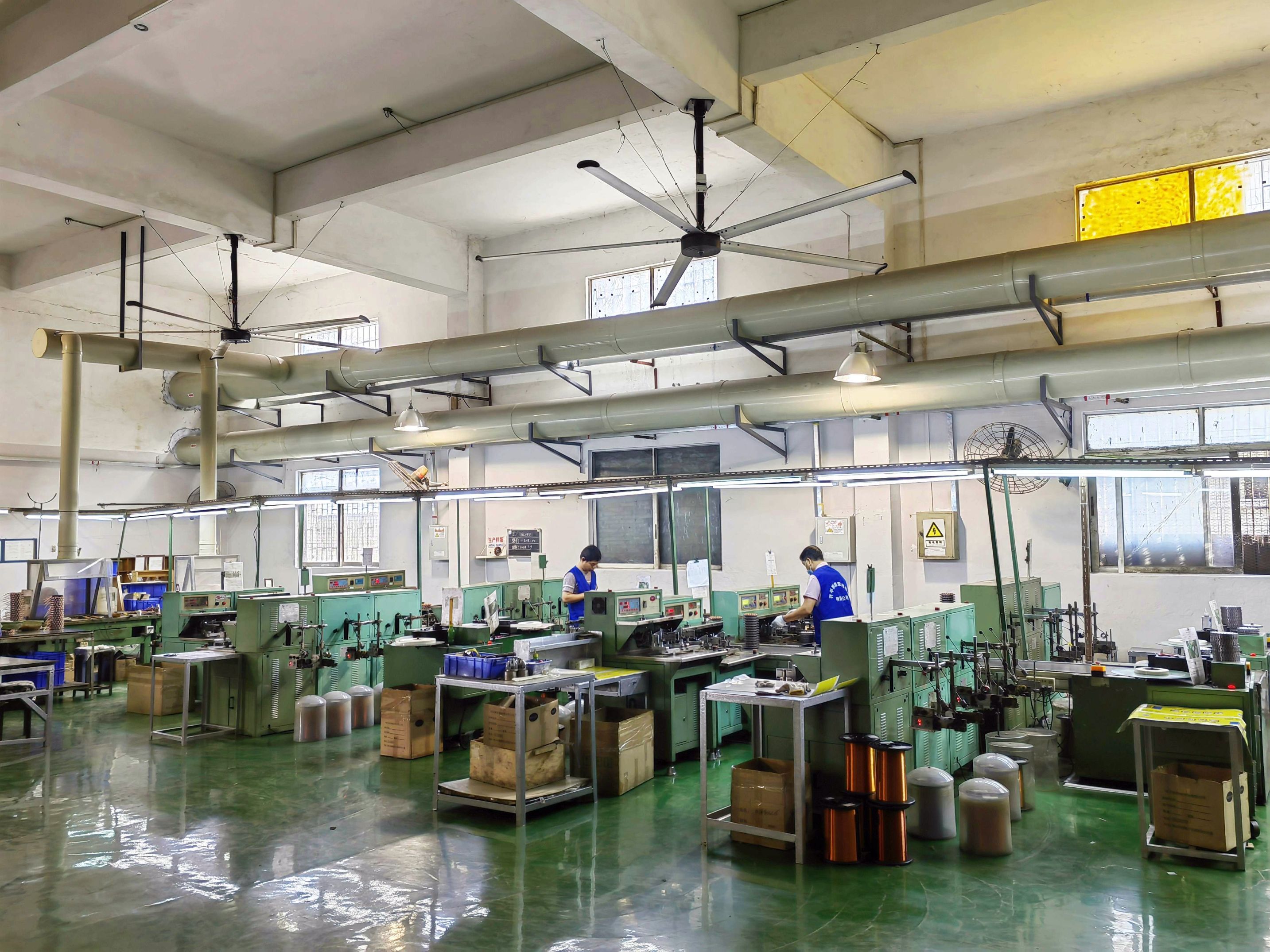
Supplier capability. On the supply side, the ceiling fan and lighting factory of Handing Co. Ltd. was ISO 9001 certified in 1996, four years after the company was established. The company produces most of its metal parts, performs its own painting and assembles its motors, and owns an electroplating factory. Since the EU RoHS regulation took effect in 2006, it has run XFS machine and chemical testing, approved by TUV PS in the same year. Its products are listed in UL, cUL, NOM, BSI, CE, GS, Swedish Standard and SAA, and its European fans are supplied with LVD/GS/TUV, EMC, EMF, RoHS and ERP approvals.
Detailed solution: what each module actually changes
The three modules can be compared on the same three questions: what each changes in the room, what each changes in the specification, and what must be verified in writing before the order.
1. The DC motor: control electronics change the whole fan
A DC ceiling fan motor runs on direct current: electronics inside the fan convert mains AC to DC and commutate the motor electronically, instead of relying on the fixed speed steps produced by an AC winding and capacitor arrangement. Speed and torque are managed by a controller, and that same controller is usually the component that hosts the remote or WiFi receiver.
For a buyer, the practical consequences are these:
- Speed resolution. DC platforms typically offer more, and finer, speed steps, which matters in bedrooms, hotel rooms and restaurants where the lowest usable speed is the one that gets used.
- Sound character at low speed. Quieter low-speed operation is a common reason to choose DC, but it depends on blade balance, housing rigidity and controller tuning rather than on motor type alone.
- One controller for two functions. Fan and light can be driven from a single controller, which simplifies both the wall interface and the app.
- Limits. Efficiency is a measured property of the whole assembly across speeds and standby. A DC motor does not make a fan efficient by itself; controller quality, driver losses and standby consumption decide the result.
In writing, ask for the motor type of the exact SKU, efficiency data expressed as a weighted CFM/W figure if an efficiency claim is made, the standby consumption, the replaceability of the controller, and the voltage and frequency of the destination market.
2. The integrated LED light kit: 24 W CCT explained
An integrated LED light kit replaces the bottom cap of the fan with a light module and its driver. On the TU52-MW-N3A1DOME the module is rated 24 W and uses a CCT LED - a light source whose white-light colour temperature can be selected instead of being fixed at the factory.
Four specification points decide whether the kit is right for a project:
- Delivered light, not just wattage. Ask for lumen output and the CCT settings that are actually available. Wattage describes input power, not how bright the room will be.
- Dimming path. Dimming behaviour has to match the control layer. A dimmable LED module driven by a non-dimmable receiver is a compatibility problem, not a light problem.
- Serviceability. If the LED board or driver cannot be replaced independently, the service life of the fan is effectively set by the light.
- Environment rating. ENERGY STAR guidance for humid locations is to look for a UL-listed damp rating, and for fans in direct contact with water a UL wet rating. In other markets the equivalent rating has to be confirmed for the model, and the light kit must carry the same rating as the fan.
3. Smart WiFi control: what the control layer really adds
Smart WiFi control turns the fan into a networked device. A receiver inside the canopy joins a local wireless network and the app becomes the primary interface, with the wall switch, remote or pull chain as the physical layer.
Decision points that are easy to miss:
- Fallback control. Confirm what happens when the network or the phone is unavailable. A fan without a physical fallback becomes a service call in a hotel or a rented property.
- App and account model. Ask which operating systems are supported, whether an account is required, and whether control is local or cloud-dependent.
- Multi-fan management. For hospitality and retail, the number of fans one account can hold, and whether scenes and schedules can be applied per room or per floor, decide the operating workload.
- Radio compliance. A WiFi module adds radio requirements on top of electrical ones. Handing Co. Ltd. states that its European fans are supplied with LVD/GS/TUV, EMC, EMF, RoHS and ERP approvals; the radio-specific approval for the WiFi module should still be confirmed for each destination market.
- Firmware. Ask how updates are delivered and whether an update can change behaviour that a project has already signed off.
Where the three modules meet
Motor, light and control share one canopy and one power supply. That creates three integration risks worth naming in a quotation: heat from the LED driver and the motor controller inside the same enclosure; interference between the radio and the motor electronics; and service access when one of the three fails. The practical rule is to buy the three modules as one validated assembly rather than as three parts that happen to fit together.
Step-by-step: specifying a decorative fan at decision stage
- Fix the room and the rating first. Indoor, humid or water-exposed; ceiling height; blade span (42, 48 or 52 inches). Environment rating removes more models from a shortlist than any styling choice.
- Decide the motor, then the evidence. Choose AC or DC on the operating requirement, then request the weighted efficiency figure and standby consumption for that model.
- Specify the light in light terms. Lumen output, CCT settings, dimming, module replaceability, and the same environment rating as the fan.
- Specify the control layer with a fallback. Name the app, the supported platforms, the physical fallback, and the number of fans per account.
- Collect model-level compliance documents. UL or ETL listing for the US; CE with LVD, EMC, EMF, RoHS and ERP for the EU; SAA for Australia; ENERGY STAR certification evidence if the programme is claimed. Confirm that the document names the model, not only the brand.
- Close the commercial loop. Landed cost including the 17.20% US duty where applicable, MOQ, sample terms, packaging, Incoterms and the confirmed production schedule.
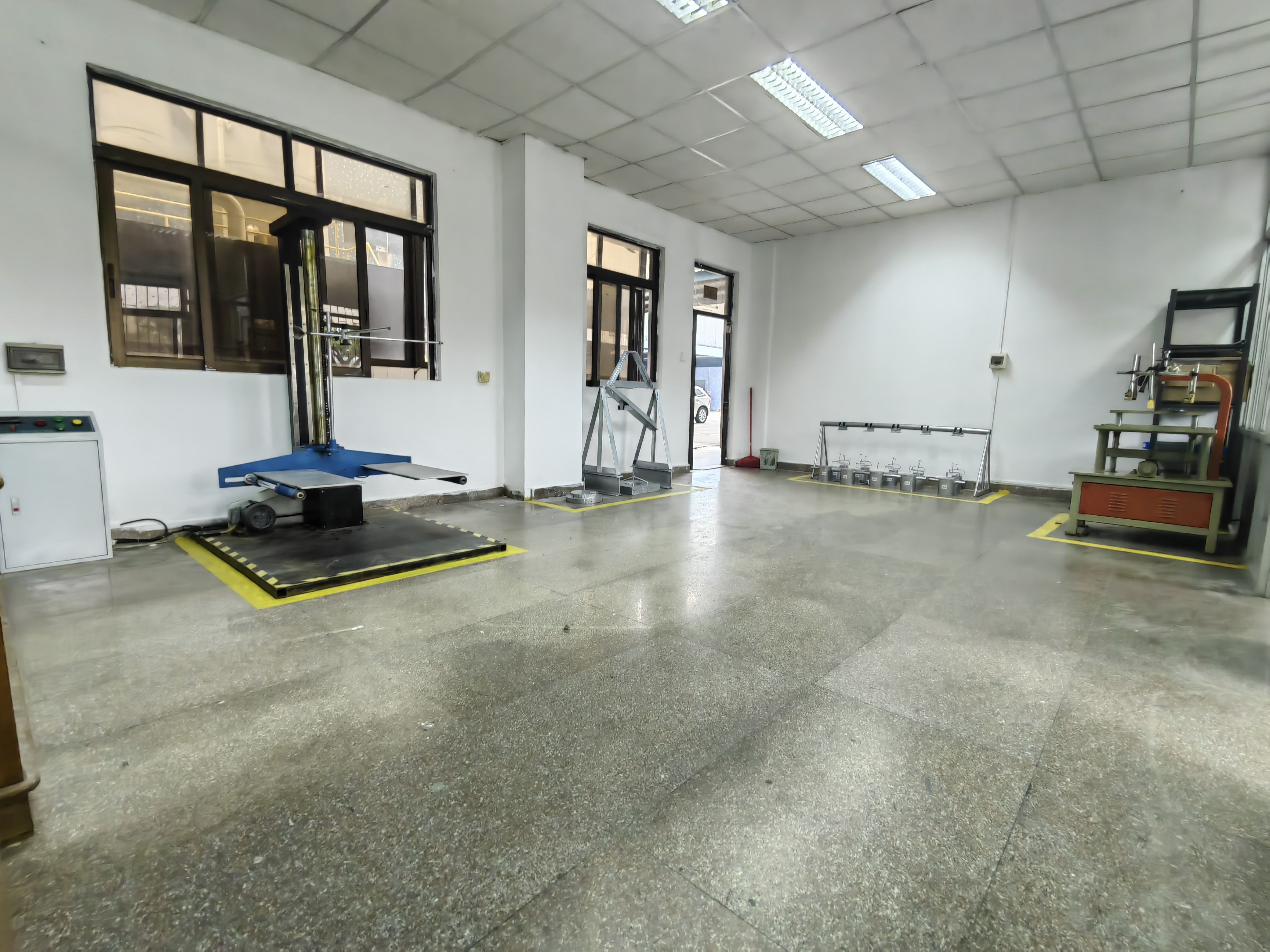
Handing Co. Ltd. supports these steps from a documented factory base: a 12,320.66 m² facility, 350 employees, an annual output of 480,000 units, a six-engineer R&D team, and 100% of output exported to the EU, USA and Australia. The in-house scope - metal parts, painting, motor assembly and a wholly owned electroplating factory - is what allows those steps to be answered by one supplier instead of four.
Use cases: where the module choice changes the outcome
Hotel guest rooms
A 52-inch decorative fan with a warm CCT setting and a usable low speed is usually the priority. WiFi is optional but useful where room-level scheduling reduces staff walks; confirm fallback control before specifying app-only operation.
Restaurants and retail floors
The light kit works as ambient lighting, so CCT switching between day and evening settings has direct operational value, and scheduling through the WiFi layer reduces manual switching across a floor.
Residential living rooms and bedrooms
DC motors and CCT light kits are the two modules buyers notice daily. A pull chain or remote fallback keeps the fan usable when the network is down.
Humid and covered outdoor areas
Environment rating is the gate. A damp-rated fan with a matching light kit is a different product from a decorative indoor fan, regardless of appearance.
Distributor range building
One 52-inch decorative platform can be sold at three specification levels - fan only, fan with integrated LED, fan with LED and smart WiFi - which covers several retail price bands without three separate tooling investments.
Comparison: module, specification level and what to verify
The first table compares the three modules on the questions that decide a purchase order. The second compares specification levels built on the same platform.
| Module | What it changes in the room | What to verify in writing | Evidence anchor |
|---|---|---|---|
| Motor (AC vs DC) | Speed resolution, sound character at low speed, energy use across speeds | Motor type for the exact SKU; weighted efficiency in CFM/W if claimed; standby consumption; controller replaceability | ENERGY STAR applies diameter-banded efficiency thresholds using a weighted CFM/W metric |
| Integrated LED kit | Light output, colour temperature options, dimming behaviour | Lumen output; CCT settings; dimming compatibility with the receiver; LED board and driver replaceability; damp or wet rating | TU52-MW-N3A1DOME: 24 W CCT LED; ENERGY STAR damp/wet rating guidance |
| Control layer | How the fan is operated, scheduled and grouped | App platforms; local or cloud control; physical fallback; fans per account; radio approval | European fans supplied with LVD/GS/TUV, EMC, EMF, RoHS and ERP approvals |
| Finish and housing | Appearance, corrosion behaviour, perceived quality | Housing material and finish process; colour consistency across batches; environment rating | TU52-MW-N3A1DOME: steel housing, Matt White finish, three ABS blades |
| Level | Configuration | Decision trigger | What it does not solve |
|---|---|---|---|
| Level 1 | Decorative fan, no light kit, pull chain or remote control | Separate lighting already specified; simplest service; lowest component count | No integrated lighting; no scheduling or app control |
| Level 2 | Decorative fan with integrated CCT LED kit, remote or pull chain | Single-fixture installation; adjustable colour temperature required | No app, scheduling or multi-fan management |
| Level 3 | Decorative fan with integrated CCT LED kit and smart WiFi control, e.g. TU52-MW-N3A1DOME | Hospitality, retail or multi-room projects needing scheduling and central control | Radio approvals and fallback control still have to be specified and verified |
FAQ: decorative ceiling fan decisions
Which certifications should a decorative ceiling fan with LED and WiFi carry for the EU, USA and Australia?
Certification is market-specific and should be confirmed at model level. Handing Co. Ltd. states that its products are listed in UL, cUL, NOM, BSI, CE, GS, Swedish Standard and SAA, and that its European fans are supplied with LVD/GS/TUV, EMC, EMF, RoHS and ERP approvals; its ceiling fan and lighting factory has been ISO 9001 certified since 1996. Where ENERGY STAR is claimed, written certification from an EPA-recognised certification body and testing in an EPA-recognised laboratory are required, so the certificate should name the model rather than only the brand.
How can a buyer check that the motor, LED kit and WiFi module are engineered as one system?
Look for evidence that one manufacturer controls the motor, the metal parts and the assembly. Handing Co. Ltd. produces most of its metal parts, performs its own painting and assembles its motors under ISO 9001 procedures, with a six-engineer R&D team and in-house XFS machine and chemical testing introduced for RoHS compliance in 2006 and approved by TUV PS. In the quotation, the practical checks are a single controller for fan and light, a documented physical fallback, and spare controllers available as service parts.
What drives the cost difference between a basic fan and a decorative DC/LED/WiFi fan?
Four cost drivers sit inside the product: the motor and its controller electronics; the LED module and driver; the radio module plus app and firmware support; and the housing and finish work. Handing's in-house scope - metal parts, painting, motor assembly and a wholly owned electroplating factory - is directly relevant to the last of these. Two landed-cost variables sit outside the product: the 17.20% US import duty under HS 8414.51.30 for permanent-installation fans from China, and the EU efficiency rules that can remove non-compliant models from a range. Compare quotations as landed cost per installed fan at an identical specification level, never as unit price alone.
Can a sample be validated before placing a production order?
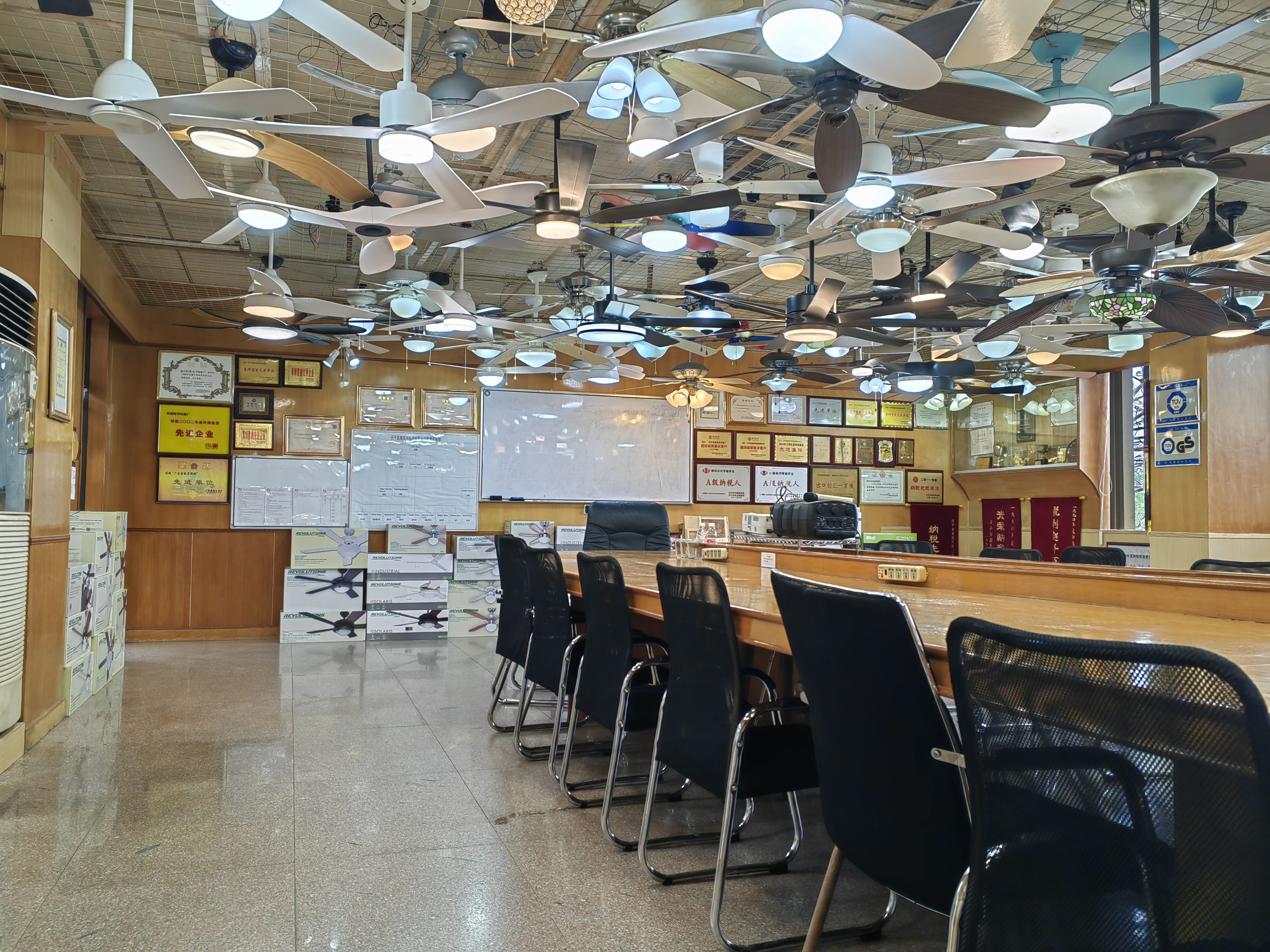
Yes, and for decorative fans it is the only reliable way to judge finish, low-speed sound and light colour. Handing Co. Ltd. maintains a sample room and exports 100% of its output to the EU, USA and Australia, so a sample can be checked against the same specification that will be produced. Request the model, finish, CCT setting and control configuration in writing, so that the sample and the production order are the same configuration.
How are lead time and capacity confirmed for a decorative ceiling fan order?
Capacity context is documented: a 12,320.66 m² factory, 350 employees, an annual output of 480,000 units and a six-engineer R&D team. The production schedule, MOQ, packaging and shipping terms are then confirmed per order in the quotation, because they depend on finish, light-kit configuration, control option and destination. To start that process, send the specification to sales@handingfan.com or contact MING LAM on +86-13828060322; the factory profile and full product presentation can be downloaded from the brochure link at the end of this article.
Conclusion: the three decisions that make the specification
A decorative ceiling fan is only decorative until it has to run for eight hours a day in a hotel room, a restaurant or a project handover. At that point the fan is judged on three decisions. The motor decides how it behaves at low speed and how its efficiency can be evidenced. The light kit decides whether the fixture works as lighting or only as an accessory. The control layer decides how the installation is operated and serviced. Finish and housing decide whether the specification still looks correct in five years.
The comparison rule that follows is simple: compare like configurations. Two quotations are only comparable when motor type, light output and CCT, control fallback, environment rating and market compliance documents are identical - and when landed cost, not unit price, is the number being compared.
Handing Co. Ltd. has manufactured decorative ceiling fans since 1992, has held ISO 9001 certification on its ceiling fan and lighting factory since 1996, and exports to the EU, USA and Australia. The TU52-MW-N3A1DOME shows how the three modules come together on a 52-inch platform: three ABS blades, a steel housing in Matt White, a 24 W CCT LED light and smart WiFi control.
Request a sample or a quotation
Send the room type, blade span, light-kit requirement and control option, and Handing Co. Ltd. will confirm the model-level specification, compliance documents and production schedule.
Factory: No.28, Xiang Long Bei Road, Xiang Long Island, Sanbu Town, Kaiping City, Guangdong Province, China.
Email: sales@handingfan.com | Tel: +86-13828060322 | WhatsApp: +852 92839029
Website: www.handingfan.com
Brochure: Handing factory presentation (PDF)
Have Questions or Need More Details?
Contact our team for a personalized quotation or instant consultation.
Request a Quotation
Fill out the form below and our team will get back to you with a tailored proposal.
WhatsApp Direct Chat
Prefer to chat in real-time? Message us on WhatsApp for instant assistance & quick answers.
- Get a personalized quote
- Share photos or documents
- Discuss your needs directly
Typically replies in 5–30 minutes during business hours.