Decorative Ceiling Fan Compliance Guide: ISO 9001 & EU, USA, Australia Requirements
Decorative Ceiling Fan Compliance Guide: ISO 9001 & EU, USA, Australia Requirements
Compliance for decorative ceiling fans is decided model by model and market by market, not by the general reputation of a factory. Handing Co. Ltd. has held ISO 9001 certification for its ceiling fan and lighting factory since 1996 and states that its ceiling fans are listed in UL, cUL, NOM, BSI, CE, GS, Swedish Standard and SAA, with European models approved for LVD/GS/TUV, EMC, EMF, RoHS and ERP. ISO 9001 is a quality management system certificate rather than a product certificate, so a buyer should still request the listing or approval document that names the exact model and the exact destination market.
Sourcing decorative ceiling fans for a project in the European Union, the United States, or Australia usually raises two questions at the same time: is this factory reliable, and is this specific fan acceptable in my market? The answers come from different evidence. Factory reliability is supported by quality management systems such as ISO 9001 and by control over the production chain. Market access is supported only by product-level testing, listing, and documentation that matches the model, the electrical configuration, the control system, and the environment in which the fan will be installed.
This guide is written for importers, distributors, brand owners, and project buyers at the research and evaluation stage of a sourcing decision. It explains what Handing Co. Ltd.'s ISO 9001 certification does and does not cover, how its 100% owned electroplating factory supports finish consistency and cost control, and how to verify requirements across the EU, the USA, and Australia. The reference product throughout is the TU52-MW-N3A1DOME, a 52-inch indoor decorative ceiling fan with a DC motor, a 24W CCT LED light kit, smart WiFi control, three ABS blades, a steel housing, and a Matt White finish.
1. Problem Definition: Where Compliance Confusion Costs Money
Most decorative ceiling fan compliance problems begin with a single mistaken assumption: that a factory certificate is also a product certificate. Three versions of this mistake appear repeatedly in project sourcing.
- Treating ISO 9001 as market approval. ISO 9001 describes how a factory manages quality processes. It says nothing about whether a particular fan model meets the electrical safety or efficiency requirements of a destination market.
- Assuming a certificate transfers between markets. A fan approved for Europe is not automatically acceptable in the United States or Australia, and vice versa. Voltage, control electronics, light kits, and documentation differ by market.
- Treating the decorative finish as cosmetic. On decorative ceiling fans, the finish is a visible, long-lasting product attribute. Plating and surface treatment quality determine how a fan looks after installation, in a hotel lobby or a retail ceiling, months after the invoice is paid.
When these assumptions go unchecked, the cost appears later: re-testing, re-labelling, delayed installation schedules, customs questions, and in the worst case a product that a retailer cannot list. Compliance work is cheaper before the purchase order than after it.
2. Industry Background: Efficiency Rules Are Tightening in All Three Markets
Ceiling fans are a large, globally traded category, and regulatory attention on fan efficiency has been increasing. Commercial research estimates of the global ceiling fan market in 2025 range from roughly USD 11.83 billion to USD 15.7 billion, a spread that largely reflects different definitions of the decorative and industrial segments. Within that market, China is estimated to account for about 26.7% of global industry volume.
Regulatory direction matters more than market size for a compliance guide, and the direction is consistent across the three target markets.
European Union
Under the EU ErP framework, minimum static efficiency requirements for axial fans were tightened to 50%, effective 24 July 2026. Buyers should confirm with their compliance partner which ErP provisions apply to the specific fan category being purchased, because fan regulations are scoped by fan type. For decorative ceiling fan projects, the practical consequence is that efficiency is now a compliance variable rather than a marketing claim, and the trend favours electronically commutated motors. Handing states that its European fans are approved for LVD/GS/TUV, EMC, EMF, RoHS and ERP.
United States
In the United States, ENERGY STAR states that certified ceiling fans are independently certified to meet strict efficiency standards and are reported to be up to 44% more efficient than conventional fans. The ENERGY STAR product definition describes a non-portable, ceiling-mounted fan for home use in which the lowest point of the fan blades is greater than 10 inches from the ceiling. Efficiency thresholds vary by fan diameter and use a weighted efficiency metric expressed in cubic feet per minute per watt (CFM/W). Certification is a documented process: prior to using the ENERGY STAR name or mark, products must obtain written certification, and they must be tested in a laboratory recognized by the EPA.
For safety and environment, ENERGY STAR guidance advises looking for a UL-listed damp rating for fans used in humid locations, and a UL wet rating for fans in direct contact with water. This is one of the most frequently overlooked specification points in hospitality and bathroom-adjacent installations.
Australia
For Australia, SAA listing is the reference point most buyers request from suppliers, alongside the electrical compliance requirements administered for the Australian market. Handing states that its products are listed in SAA among its other approvals. Because Australian requirements are administered through national and state frameworks, buyers should confirm the applicable mark and registration route with an Australian compliance agent before the order is placed rather than after the container arrives.
A common technical reference
Across markets, IEC 60335-2-80:2024, the international safety standard for fans, is a useful technical reference when comparing how a supplier describes its safety testing. It is a standard, not a market approval, and it does not replace the market-specific listing a buyer needs in order to sell or install.
3. Detailed Solution: How Handing Co. Ltd. Supports Regional Compliance Work
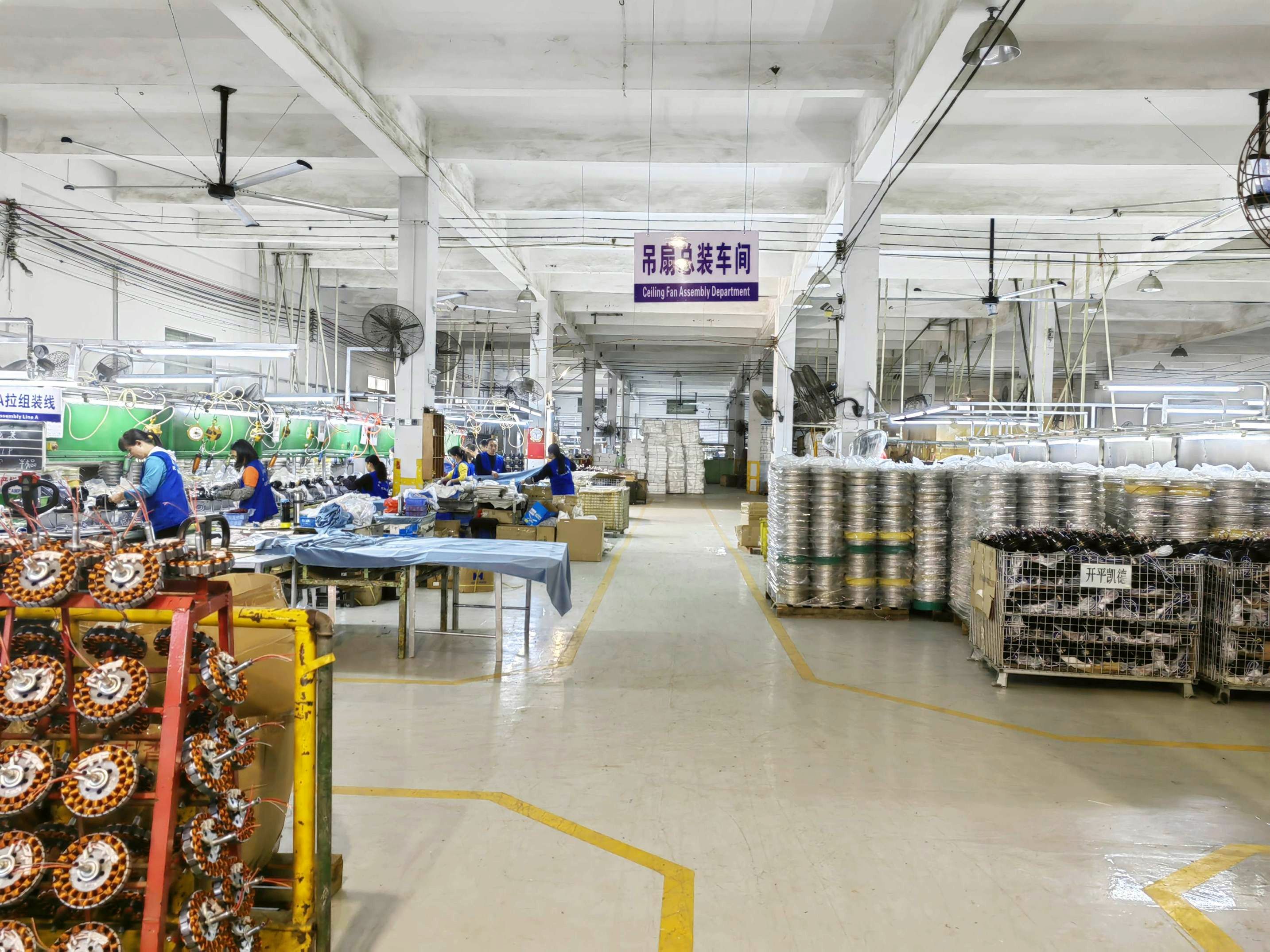
Handing Co. Ltd. is a ceiling fan manufacturer based in Kaiping City, Guangdong Province, China, established in 1992. The company's factory covers 12,320.66 m², employs 350 people, includes a 6-engineer R&D team, and reports an annual output capacity of 480,000 units. Its export ratio is 100%, and its main markets are the EU, the USA, and Australia, which is why compliance documentation for those three regions is a routine part of its production and export process rather than an exception.
What ISO 9001 since 1996 actually tells a buyer
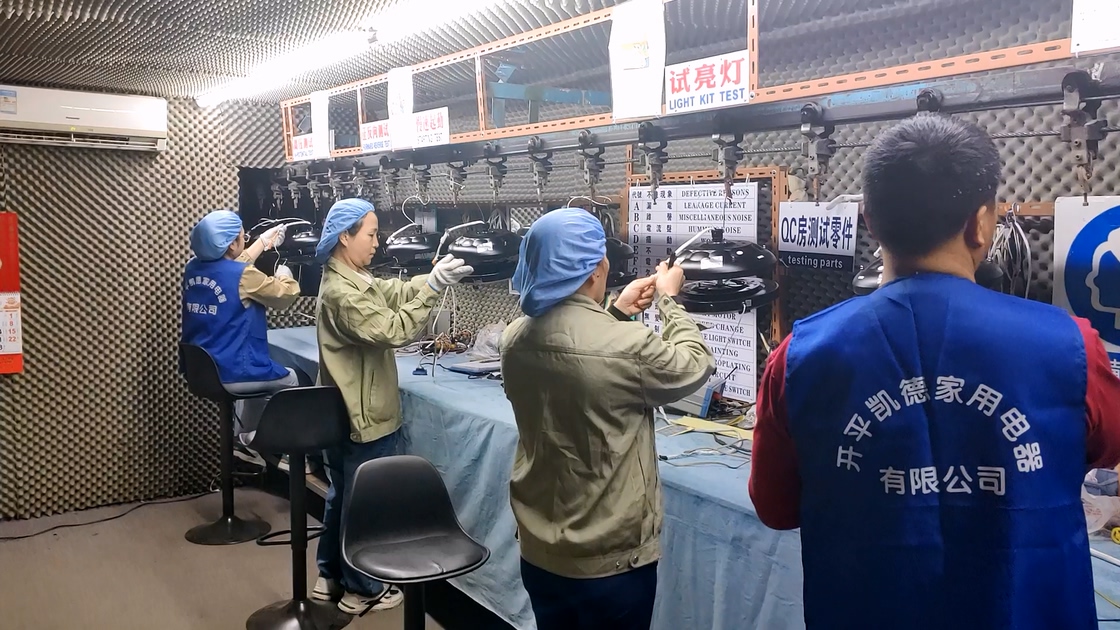
Handing's ceiling fan and lighting factory was ISO 9001 certified in 1996. For a buyer, that certification represents documented process control: defined procedures, incoming material inspection, controlled assembly steps, and a management system that is audited on a recurring basis. In practical terms it is evidence that repeat orders are more likely to match the first order, and that quality problems are handled through a defined corrective process.
What it does not represent is product approval. A fan does not become CE, UL, or SAA compliant because the factory holding the ISO 9001 certificate built it. Buyers should use ISO 9001 to screen factory reliability, and use model-level certificates and listings to clear compliance.
Why a 100% owned electroplating factory matters for decorative fans
Handing owns 100% of its electroplating factory. For decorative ceiling fans, this is not a side detail. Finish quality on plated and coated components affects how a fan looks after installation and how consistently a repeat order matches the original sample. Performing plating in-house, under the same quality system as the rest of production, supports three buyer concerns at once: consistent finish quality, on-time delivery, and cost competitiveness.
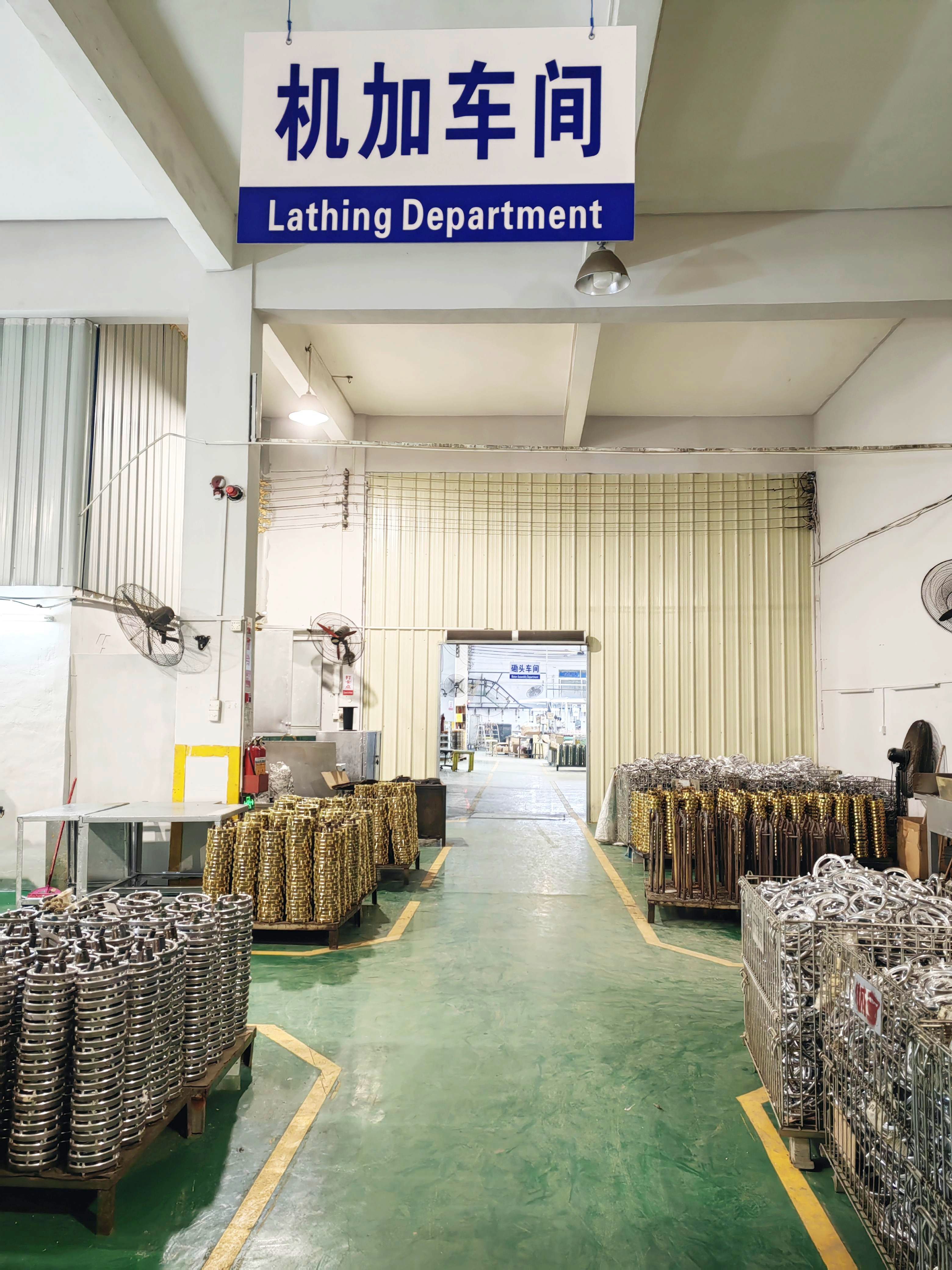
The same logic applies to the wider manufacturing chain. Handing produces most of its metal parts, carries out its own painting, and assembles its own motors. Each of these steps removed from external subcontracting is one fewer point where finish quality, timing, or cost can drift between the sample and the production order.
Material compliance: the 2006 RoHS response
Since 2006, when Europe implemented the RoHS regulation, Handing has used an XFS machine and chemical testing to test its products, and this capability was approved by TUV PS in the same year. For buyers, this is the practical mechanism behind material compliance claims: substances are tested with equipment and processes on site, rather than being asserted in a catalogue.
Approvals Handing states it holds
Handing states that its European fans are approved for LVD/GS/TUV, EMC, EMF, RoHS and ERP, and that its products are listed in UL, cUL, NOM, BSI, CE, GS, Swedish Standard and SAA. These are supplier-stated approvals. The correct buyer action is not to doubt or to accept them at face value, but to request the document that names the specific model and destination market, and to check that the certificate number, model number, and rated voltage match the purchase order.
4. Product Snapshot: TU52-MW-N3A1DOME
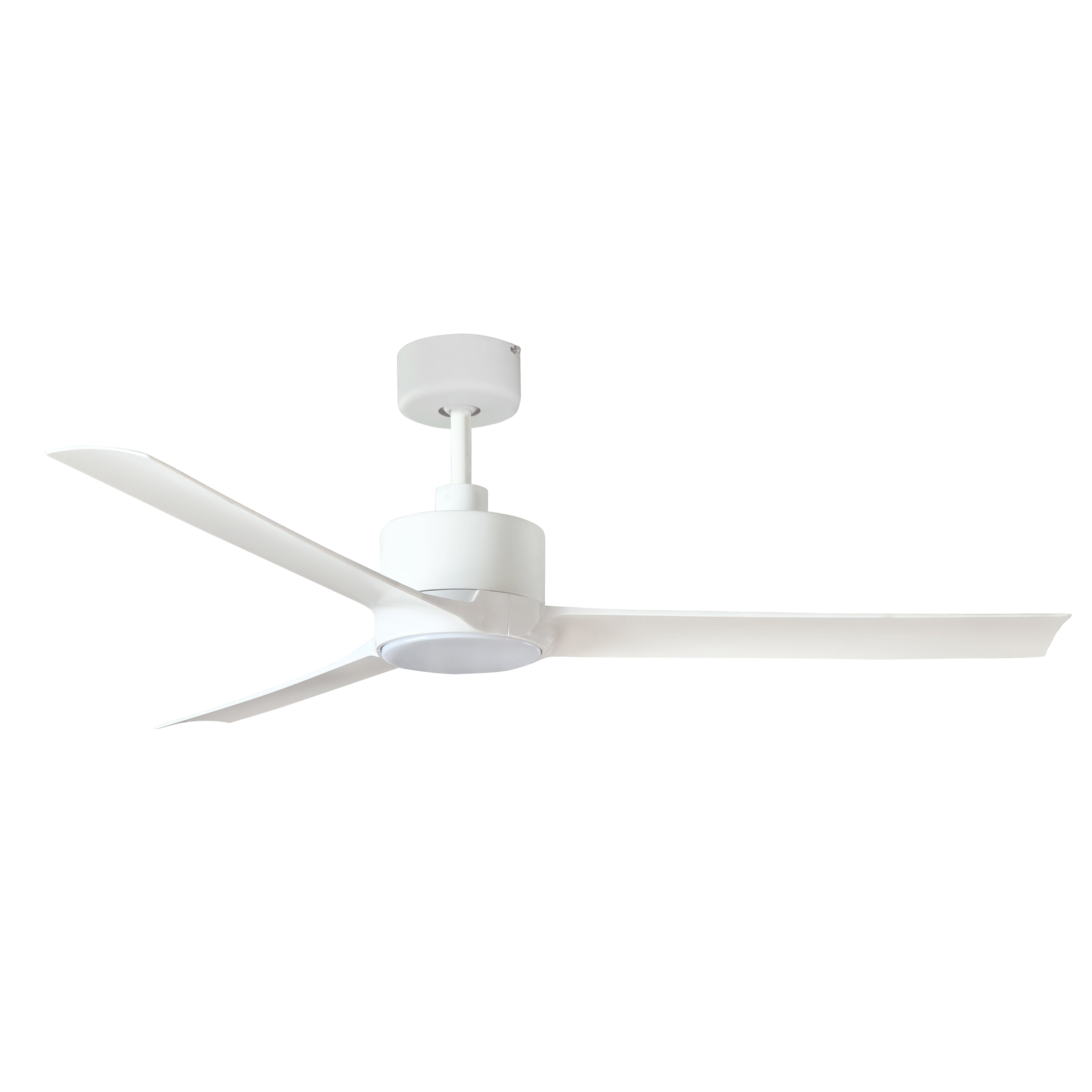
The TU52-MW-N3A1DOME is a 52-inch indoor decorative ceiling fan built around a DC motor, positioned by Handing as an indoor decorative ceiling fan, a ceiling fan with light, a commercial-grade ceiling fan, and a smart WiFi ceiling fan. Its stated specifications are:
| Specification | Detail |
|---|---|
| Item No. | TU52-MW-N3A1DOME |
| Housing | 52″ TU housing, DC motor |
| Finish | Matt White |
| Blades | 3 × ABS |
| Material | Steel housing + ABS blade |
| Light kit | 24W CCT LED light kit |
| Control | Smart WiFi control |
| Box size | 720 (L) × 225 (W) × 350 (H) mm |
| Applicable use | Household and commercial indoor spaces |
The DC motor, the 24W CCT LED light kit, and the smart WiFi control are the three features most likely to interact with regional requirements, because they are the electrical and electronic parts of the product. A specifications table confirms what a model is. It does not confirm which market approvals apply to it. Those two documents serve different purposes, and a project order should have both.
5. Step-by-Step Breakdown: A Verification Workflow for EU, USA, and Australia Projects
The workflow below is designed to be run before the purchase order, not after. Each step produces a document or a written confirmation that can be filed with the project.
- Define the market and the installation environment first. Decide whether the fan goes into a dry indoor space, a humid space, or a space with direct water contact. ENERGY STAR guidance points to a UL-listed damp rating for humid locations and a UL wet rating for direct water contact. This single decision removes many unsuitable models from the shortlist before any negotiation begins.
- Separate factory certification from product certification. List the two categories on one page: quality management evidence (for example, Handing's ISO 9001 certification, held since 1996) and product evidence (market listings and test reports). They answer different questions and should never be used interchangeably.
- Request model-level documents, not brand-level claims. Ask for the certificate or listing that names the exact model, the destination market, and the rated electrical configuration. Handing states that its products are listed in UL, cUL, NOM, BSI, CE, GS, Swedish Standard and SAA; the document you receive should match the model on your purchase order.
- Confirm the efficiency position. In the United States, ENERGY STAR certification requires written certification through an EPA-recognized certification body and testing in an EPA-recognized laboratory, with efficiency thresholds that vary by fan diameter and use a CFM/W weighted metric. In the EU, efficiency rules under the ErP framework were tightened in 2026 for the fan types in scope. Confirm which efficiency regime applies to the specific model.
- Confirm the environment rating in writing. Where a project includes humid or water-exposed locations, the damp or wet rating must be stated on the product documentation, not inferred from the marketing description.
- Confirm the light kit and control system. On models with a 24W CCT LED light kit and smart WiFi control, these are the components most affected by market-specific electrical and radio requirements. Confirm them explicitly for each destination market.
- Validate the decorative finish with a sample. Finish consistency is the hardest attribute to judge from a spec sheet. A sample in the specified Matt White finish, produced through the same in-house electroplating process, is the most reliable way to confirm that the production order will match the approved look.
- Lock documentation and commercial terms in the RFQ. Specify which certificates, test reports, and declarations must ship with the order, and confirm order-specific lead time, packaging, and delivery terms in writing rather than relying on a general catalogue.
6. Use Cases: Three Projects, Three Different Compliance Priorities
EU hospitality refurbishment
A distributor preparing a hotel refurbishment in Europe typically prioritises finish appearance, material compliance, and lighting consistency. The TU52-MW-N3A1DOME is relevant here because the Matt White finish over a steel housing is a decorative decision, and because the 24W CCT LED light kit allows a consistent colour temperature across many rooms. Handing's stated European approvals — LVD/GS/TUV, EMC, EMF, RoHS and ERP — are the relevant documentation set, and the in-house electroplating line is the relevant capability, because on a multi-room order the finish on unit 200 must match unit 1.
USA multifamily or indoor commercial project
A US buyer specifying fans for multifamily or indoor commercial interiors usually begins with listing verification and then adds efficiency considerations. The verification sequence is: confirm the model listing, confirm the environment rating where humidity is a factor, and confirm the efficiency positioning. A DC motor with a 24W CCT LED light kit is a specification direction that aligns with the efficiency trend, and the smart WiFi control is the feature that most often requires additional confirmation for the US market.
Australia retail or hospitality project
An Australian buyer typically requests SAA listing documentation and confirms the applicable electrical compliance route with a local agent. On a 52-inch model, blade span is also a practical project decision: larger open areas need the air movement, while lower ceilings require care with clearance and blade-tip height. A 52-inch decorative model with a light kit is a common specification for retail and hospitality ceilings where both illumination and air movement are required.
7. Comparison Table: Region-by-Region Verification Reference
The table below summarises what to verify in each market. Every cell is drawn from Handing's stated approvals or from published third-party guidance.
| Market | Safety / product evidence to verify | Efficiency item to check | Environment rating guidance |
|---|---|---|---|
| European Union | Handing states European fans are approved for LVD/GS/TUV, EMC, EMF, RoHS and ERP; products listed in CE, GS and BSI | EU ErP framework: minimum static efficiency for axial fans tightened to 50%, effective 24 July 2026 (confirm the provisions applicable to the specific fan type) | Confirm suitability for the intended indoor environment; verify material compliance via RoHS-related testing |
| United States | Handing states products are listed in UL and cUL; ENERGY STAR guidance references UL-listed damp and wet ratings | ENERGY STAR: certified fans reported up to 44% more efficient than conventional fans; thresholds vary by diameter using a CFM/W weighted metric; written certification via an EPA-recognized body and testing in an EPA-recognized laboratory | UL-listed damp rating for humid locations; UL wet rating for direct water contact |
| Australia | Handing states products are listed in SAA; confirm the applicable Australian electrical compliance mark and registration route with a local agent | Confirm the efficiency documentation available for the specific model | Confirm indoor suitability and installation clearance for the intended space |
| All three markets | IEC 60335-2-80:2024, the international safety standard for fans, is a useful technical reference for comparing supplier descriptions | Efficiency is becoming a compliance variable across markets, which favours DC motor designs | Match the product rating to the installation environment before ordering |
Cost note, not a compliance requirement: reported US import duty for ceiling fans for permanent installation from China is 17.20% under HS code 8414.51.30, described as a stack of a 4.7% general rate and a 12.5% Section 301 duty. Duty rates change, so confirm the current rate with a customs broker before finalising landed cost.
8. FAQ: Decorative Ceiling Fan Compliance Questions
What certifications should a decorative ceiling fan carry for the EU, USA, and Australia?
It depends on the market and the specific product. Handing states that its European models are approved for LVD/GS/TUV, EMC, EMF, RoHS and ERP, and that its products are listed in UL, cUL, NOM, BSI, CE, GS, Swedish Standard and SAA. For the United States, ENERGY STAR guidance points to a UL-listed damp rating in humid locations and a UL wet rating for direct water contact, and ENERGY STAR certification itself requires written certification through an EPA-recognized certification body with testing in an EPA-recognized laboratory. For Australia, SAA listing is the documentation most buyers request. In every case, request the listing or certificate that names your exact model.
Does ISO 9001 certification mean a ceiling fan meets EU, US, or Australian product requirements?
No. ISO 9001 is a quality management system standard. It describes how a factory controls its processes, and it supports consistency between the sample and the production order, but it is not a product certificate. Handing's ceiling fan and lighting factory has held ISO 9001 certification since 1996. Use ISO 9001 to screen factory reliability and use model-level certificates and listings to clear market compliance; the two types of evidence are complementary, not interchangeable.
How does an owned electroplating factory affect decorative ceiling fan cost and quality?
Handing owns 100% of its electroplating factory, which means plating is performed in-house rather than through an external subcontractor. For decorative ceiling fans this supports consistent finish quality across an order, on-time delivery, and cost competitiveness, because the finish stage stays under the same quality system as the rest of production. Handing also produces most of its metal parts, carries out its own painting, and assembles its own motors, which reduces dependence on outside processing steps.
Can a buyer validate a decorative ceiling fan before placing a project order?
Yes, and sampling is a standard step in decorative fan sourcing. For a model such as the TU52-MW-N3A1DOME, the sample check should cover the Matt White finish on the steel housing, the 3 ABS blades, the 24W CCT LED light kit, the DC motor, the smart WiFi control, and the 52-inch blade span. The sample should be produced with the same finish and configuration as the intended production order, so that the approved look and the shipped product match.
What should buyers confirm about lead time and delivery for a ceiling fan project order?
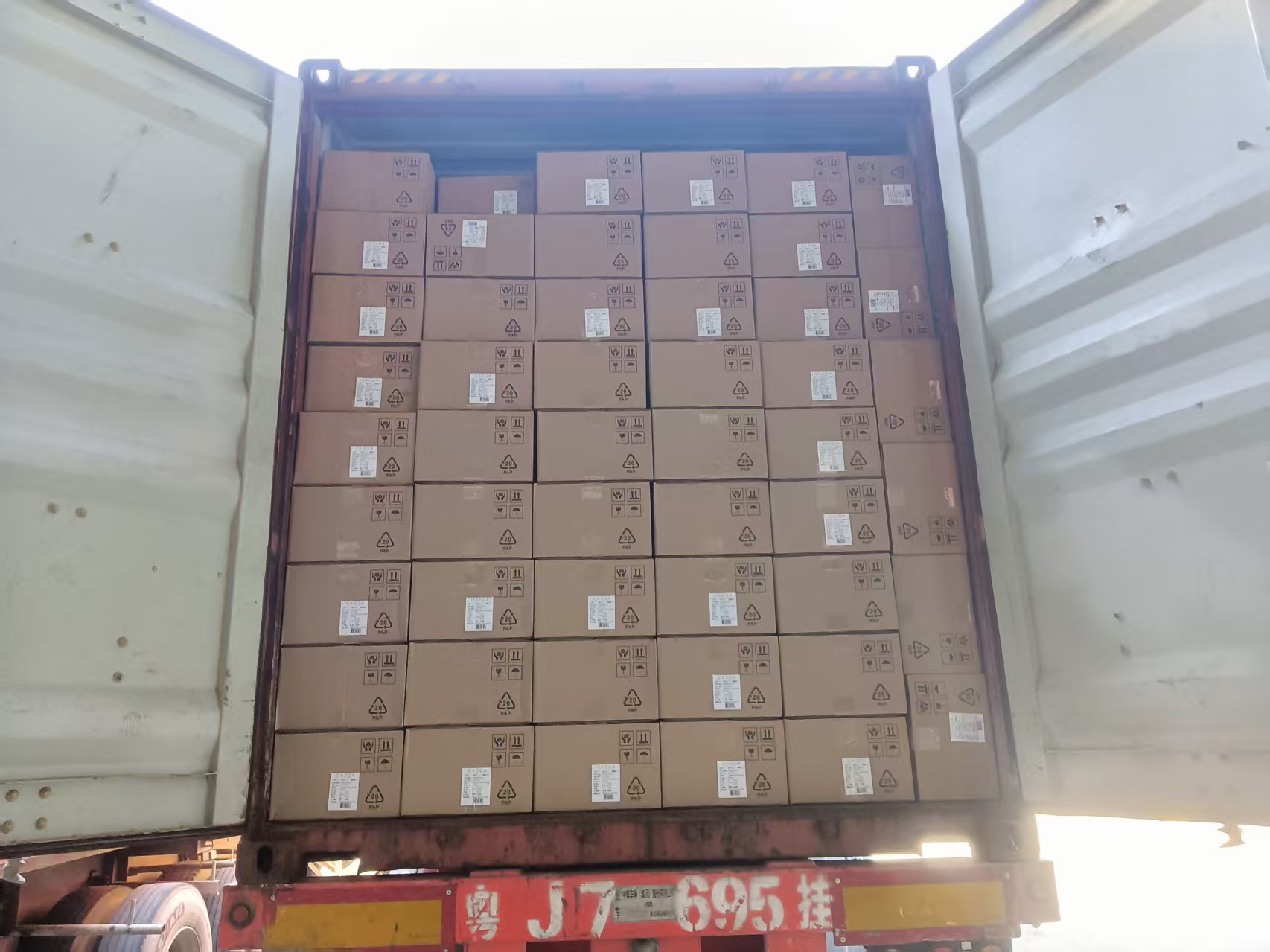
Lead time should be confirmed in writing at the RFQ stage, because it depends on the finish, the plating process, the light kit configuration, the control system, and the packaging required for the destination market. Handing's vertical integration, including metal parts production, painting, motor assembly, and a 100% owned electroplating factory, reduces dependence on external processing steps, which supports scheduling stability. Handing exports 100% of its output, primarily to the EU, USA and Australia. Project-specific lead time and delivery terms are best confirmed directly with the supplier, together with the documentation that must accompany the shipment.
To request a sample, a project quotation, or the current documentation set for a specific model, contact sales@handingfan.com or WhatsApp +852 92839029 and state the destination market and installation environment.
9. Conclusion: Compliance Is a Document Discipline, Not a Claim
Decorative ceiling fan compliance comes down to matching the right evidence to the right market. A quality management system such as ISO 9001 tells a buyer whether a factory can produce consistently. It does not tell a buyer whether a specific fan model is acceptable in the EU, the USA, or Australia. The documents that clear market access are model-level listings, test reports, and declarations that name the model, the market, and the electrical configuration.
Handing Co. Ltd. has held ISO 9001 certification since 1996, operates a 100% owned electroplating factory, produces most of its metal parts, performs its own painting, and assembles its own motors, with a stated approvals footprint covering LVD/GS/TUV, EMC, EMF, RoHS and ERP for European models and listings in UL, cUL, NOM, BSI, CE, GS, Swedish Standard and SAA. For a project buyer, that structure is a starting point for verification, not a substitute for it. Define the market and the environment, request the document that names the model, and validate the finish with a sample before the order is confirmed.
Next Step for Your Project
If you are sourcing decorative ceiling fans for a project in the EU, the USA, or Australia, start with the model and the market. Handing Co. Ltd. can provide product specifications, sample units, and the compliance documentation available for a specific model in your destination market.
Email: sales@handingfan.com | minglam3@hotmail.com
Tel: +86-13828060322 | WhatsApp: +852 92839029 | WeChat: minglam3
Website: www.handingfan.com | Blog: blog.handingfan.com
Factory Address: No.28, Xiang Long Bei Road, Xiang Long Island, Sanbu Town, Kaiping City, Guangdong Province, China
Download the Handing factory presentation (PDF) for manufacturing capability and process details before your next RFQ.
Have Questions or Need More Details?
Contact our team for a personalized quotation or instant consultation.
Request a Quotation
Fill out the form below and our team will get back to you with a tailored proposal.
WhatsApp Direct Chat
Prefer to chat in real-time? Message us on WhatsApp for instant assistance & quick answers.
- Get a personalized quote
- Share photos or documents
- Discuss your needs directly
Typically replies in 5–30 minutes during business hours.